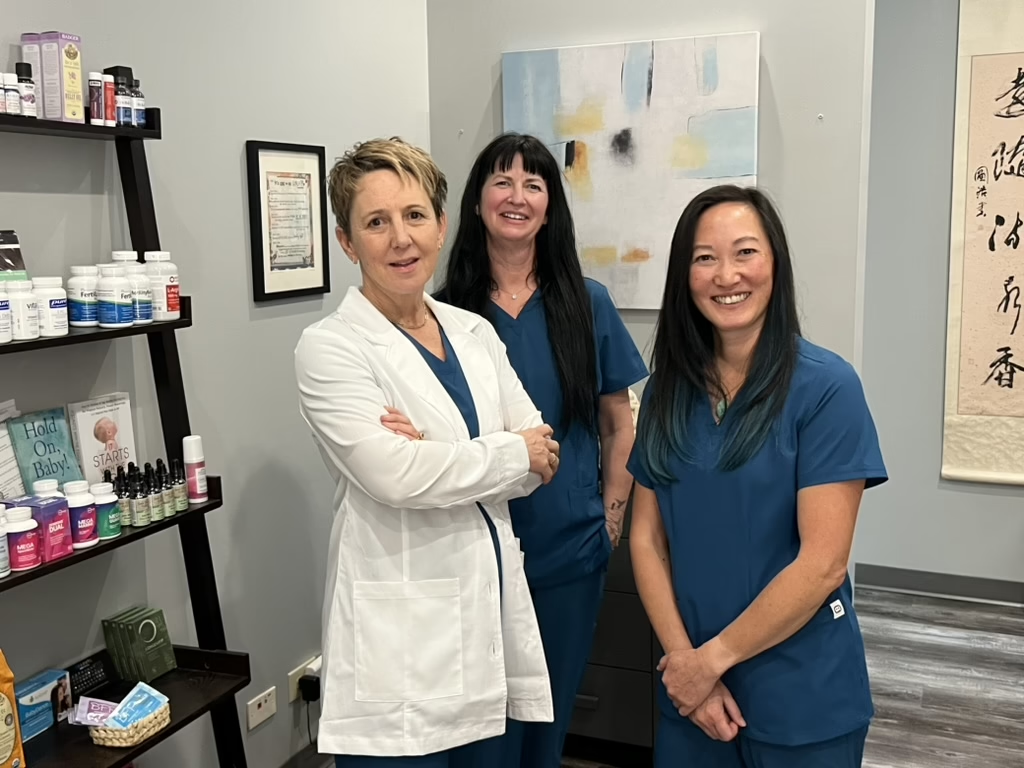
By Jane Gregorie, M.S., L.Ac., FABORM
Owner & Clinic Director
Introduction
“Is acupuncture safe in pregnancy?” It’s one of the most common questions we hear — usually from someone who is excited, a little nervous, and dealing with symptoms that are making the days harder than they expected. Maybe a friend swore acupuncture got her through morning sickness. Maybe your midwife mentioned it for your back. Or maybe you’ve been coming to us for fertility support and now, finally, you’re pregnant — and you’re wondering whether it’s okay to keep coming.
The short answer: when it’s provided by a licensed, well-trained practitioner who modifies treatment for pregnancy, acupuncture has a reassuring safety record. The longer answer — what the research actually shows, what acupuncture can and can’t help, and what we do differently for pregnant patients — is what this guide covers.
This guide is for you if you are:
- Newly pregnant and wondering whether acupuncture is safe in the first trimester
- Struggling with nausea, back pain, pelvic pain, poor sleep, or stress during pregnancy
- Transitioning from fertility acupuncture into pregnancy and wondering whether to continue
- Pregnant after a loss and looking for extra support (see our post on acupuncture for recurrent pregnancy loss)
- Approaching 32–37 weeks with a breech baby, or preparing for labor
- Looking for a non-medication option to use alongside your OB-GYN or midwife’s care
At Acupuncture Denver, prenatal care is a core part of our practice, not an add-on. We’ve supported many patients from their first positive test through birth and into the postpartum months, and we do it in close coordination with Denver-area OB-GYNs and midwives.
What Is Prenatal Acupuncture?
Prenatal acupuncture is acupuncture adapted for pregnancy. Very fine, sterile, single-use needles are placed at specific points to ease common pregnancy symptoms, with point selection, needle depth, stimulation strength, and positioning all modified for each trimester. It is often combined with moxibustion (gentle heat from the herb mugwort), acupressure you can do at home, and nutrition and lifestyle guidance.
Why do so many pregnant people look for it? Because pregnancy symptoms are common and medication options are often limited or something people prefer to minimize:
- Nausea and vomiting affect roughly half to most pregnant women to some degree, and the American College of Obstetricians and Gynecologists (ACOG) notes that it is often minimized and undertreated — partly because some women avoid medications out of safety concerns (ACOG, 2018).
- Low back and pelvic pain are extremely common: a Cochrane review notes that more than two-thirds of pregnant women experience low back pain and almost one-fifth experience pelvic pain, with pain typically increasing as pregnancy advances and interfering with work, daily activities, and sleep (Liddle & Pennick, 2015).
- Depression and anxiety during pregnancy are common and important to treat, and many patients want options to use alongside counseling and, when appropriate, medication (Manber et al., 2010).
Good nutrition matters throughout pregnancy, too — see our posts on choline during pregnancy and magnesium for fertility and pregnancy.
Is Acupuncture Safe in Pregnancy? What the Safety Research Shows
This is the heart of the question, so let’s look at the evidence directly.
1. Adverse events are uncommon and mostly mild
The most-cited safety review, published in Acupuncture in Medicine, examined 105 studies of acupuncture and moxibustion in pregnant women. The incidence of adverse events judged as certainly, probably, or possibly related to acupuncture was 1.3%, and those events were all mild to moderate — most often brief needling pain or minor bleeding at the needle site. Severe events were rare and were judged unlikely to have been caused by acupuncture. The authors concluded that acupuncture during pregnancy “appears to be associated with few AEs when correctly applied” (Park et al., 2014).
2. Side effects look similar to those in comparison groups
A second systematic review, focused on trials using penetrating needles in pregnancy, found that 14–17% of women in acupuncture groups and 15–19% of women in non-acupuncture groups reported an adverse event — in other words, broadly comparable rates. The reviewers also noted that the quality of side-effect reporting in many trials is poor, which is an honest limitation of this research (Clarkson et al., 2015).
3. No increase in preterm birth or stillbirth in a large population study
A retrospective cohort study using Korea’s National Health Insurance data followed 20,799 pregnant women, 1,030 of whom received acupuncture. There was no statistically significant difference in preterm delivery between acupuncture and control groups (OR 1.23; 95% CI 0.98–1.54), including among high-risk pregnancies (OR 1.09; 95% CI 0.73–1.64), and no stillbirths occurred in the acupuncture group (Moon et al., 2020). Because this is an observational study, it can show association rather than prove safety — but it is reassuring at scale.
4. Large trials report no serious harm to mother or baby
In a large Swedish trial of acupuncture for pelvic girdle pain beginning in the second trimester, researchers tracked outcomes for the pregnancy, delivery, and newborn and found no serious adverse events; minor effects such as needling discomfort were common, yet women still rated acupuncture favorably (Elden et al., 2008). Similarly, follow-up of 593 women treated in early pregnancy for nausea found no differences in perinatal outcomes, congenital abnormalities, or pregnancy complications compared with women who didn’t receive acupuncture (Smith et al., 2002b).
5. What about “forbidden points”?
Classical Chinese medicine texts list certain points as “forbidden” or cautioned in pregnancy. A review of the scientific literature found no objective evidence of harm from needling these points, including in 15 clinical trials and a large observational cohort (Carr, 2015). Even so, we take a conservative approach: we avoid traditionally cautioned points before 37 weeks unless there is a clear, OB-coordinated reason. When good alternatives exist, there’s no reason to take an unnecessary chance.
The bottom line on safety: the evidence consistently shows that acupuncture in pregnancy is low risk when delivered by a properly trained practitioner. That last part matters — training, technique, and judgment are what make it safe.
What Prenatal Acupuncture May Help: A Closer Look at the Research
Here’s an honest summary of where the evidence is strongest, and where it’s still developing.
Pregnancy-related back and pelvic pain — good evidence. In a randomized trial of 386 women with pelvic girdle pain, acupuncture added to standard care reduced pain, and the acupuncture group had less evening pain than the group doing stabilizing exercises (Elden et al., 2005). The Cochrane review of back and pelvic pain in pregnancy also concluded that evidence from single studies suggests acupuncture improves pregnancy-related pelvic pain, while calling for more high-quality trials (Liddle & Pennick, 2015). This is one of the most common reasons patients come to us.
Nausea and morning sickness — mixed evidence. In an Australian trial of 593 women less than 14 weeks pregnant, those receiving traditional acupuncture reported less nausea and less dry retching than women in a no-acupuncture control group (Smith et al., 2002). Results across nausea trials are mixed overall, so we see acupuncture as a helpful complement to your provider’s recommendations — not a replacement for them, especially if vomiting is severe.
Breech presentation — moxibustion is the best-studied option. Moxibustion at the acupuncture point BL67 (Zhiyin, at the outer corner of the little toe) has been studied for decades. The 2023 Cochrane review included 13 studies with 2,181 women and found that moxibustion plus usual care probably reduces the number of babies still breech at birth compared with usual care alone, based on moderate-certainty evidence (Coyle et al., 2023). An earlier randomized trial in JAMA suggested it may work by increasing fetal movement (Cardini & Weixin, 1998). This is typically done between about 32 and 37 weeks, after your provider confirms the baby’s position.
Depression during pregnancy — a meaningful early signal. In a randomized controlled trial at Stanford, 150 pregnant women with major depression received 12 sessions over eight weeks of depression-specific acupuncture or one of two active controls. Women in the depression-specific acupuncture group had a greater rate of symptom improvement (Manber et al., 2010). Acupuncture is never a substitute for mental health care, but it can be a valuable part of a team approach.
Labor support — mixed evidence. A 2020 Cochrane review found acupuncture may increase satisfaction with pain relief and probably reduces the use of pain medication compared with sham acupuncture, though it may make little or no difference to pain intensity (Smith et al., 2020). In practice, many patients use birth-preparation treatments from 36 weeks to feel calmer, sleep better, and enter labor more relaxed.
What the evidence means for you: Acupuncture won’t fix every pregnancy symptom, and the quality of research varies by condition. But for pelvic and back pain and breech presentation there is meaningful evidence of benefit, with smaller or mixed evidence for nausea and mood — and the safety profile is reassuring. That’s a favorable balance for many expecting parents, particularly those who want to limit medications.
How Acupuncture May Help During Pregnancy (Biological Perspective)
Researchers are still working out exactly how acupuncture produces its effects, but several pathways are proposed:
1. Pain modulation
Research suggests acupuncture may affect the nervous system, including how the brain processes pain, which is one proposed reason it may help pregnancy-related back and pelvic pain (NCCIH).
2. Nausea pathways
Points such as PC6 (Neiguan) on the inner wrist are among the most commonly studied points for nausea, including in pregnancy trials, and are commonly included in prenatal protocols (Smith et al., 2002).
3. Fetal activity
For breech presentation, moxibustion at BL67 was associated with increased fetal movements in a randomized trial, which may help the baby turn (Cardini & Weixin, 1998).
4. Stress and mood regulation
Treatment sessions are deeply relaxing, and depression-specific protocols have shown benefit for mood in pregnancy (Manber et al., 2010).
5. Sleep and recovery
Many patients report better sleep after treatment. While sleep-specific pregnancy trials are still limited, easing pain, nausea, and stress often improves rest in turn.
Traditional Chinese Medicine Perspective on Pregnancy
In Chinese medicine, pregnancy is a time when the body’s resources are directed toward nourishing the baby. Symptoms arise when that shift creates imbalance. We individualize every treatment based on your pattern.
Spleen Qi Deficiency
Associated with:
- Fatigue and heaviness
- Poor appetite, loose stools
- Nausea that worsens when tired
Treatment principle: strengthen digestion and energy so the body can “hold” and nourish the pregnancy.
Rebellious Stomach Qi (with Chong Vessel Disharmony)
Associated with:
- Morning sickness, vomiting, food aversions
- Acid reflux or heartburn
- Symptoms worse in the first trimester
Treatment principle: calm and descend Stomach Qi to settle nausea.
Kidney Deficiency
Associated with:
- Low back ache, weak knees
- History of miscarriage or threatened miscarriage
- Fatigue, frequent urination
Treatment principle: support the Kidney to stabilize and nourish the pregnancy.
Blood Deficiency
Associated with:
- Dizziness, pale complexion
- Insomnia, palpitations
- Fatigue, especially in later pregnancy
Treatment principle: nourish Blood to support both parent and baby.
Liver Qi Stagnation
Associated with:
- Irritability, anxiety, low mood
- Rib-side or breast tension
- Stress-related tension headaches
Treatment principle: smooth the flow of Qi to ease stress and emotional strain.
What a Personalized Plan Looks Like at Acupuncture Denver
Every pregnancy is different, so every plan is too. A typical prenatal plan includes:
- A thorough intake — your health history, any prior pregnancy losses, your provider’s notes, and a Chinese medicine assessment
- Trimester-appropriate treatment — gentle needling, modified point selection, and comfortable positioning (side-lying with pillows as your belly grows)
- A suggested schedule — commonly every two weeks in the first trimester, monthly in the second, and weekly from 36 to 40 weeks for birth preparation, adjusted for your symptoms
- Symptom-focused care — treatment for nausea, back and pelvic pain, headaches, sleep, and mood as they come up
- Moxibustion for breech — in-clinic treatment plus home instructions when your provider confirms breech presentation
- Home acupressure — simple points you or your partner can use between visits
- Conservative herbal guidance — we use Chinese herbs very selectively in pregnancy, only when clearly indicated and coordinated with your OB-GYN or midwife
- Nutrition and supplement guidance — through our Fullscript pharmacy, always aligned with your prenatal care
- Coordination with your care team — we routinely work alongside Denver-area OB-GYNs and certified nurse midwives
- Postpartum continuity — support for recovery, sleep, milk supply, and mood after birth (see our Pregnancy & Postpartum page)
When to Start Acupuncture in Pregnancy
You can begin at any point in pregnancy, including the first trimester, once your pregnancy is confirmed and your provider is aware. Many of our fertility patients simply continue care after a positive test, with treatment adjusted for pregnancy.
Consider scheduling if:
✔ You’re in the first trimester and nausea or fatigue is affecting your daily life
✔ You’re pregnant after a loss and want extra support and reassurance
✔ Back, hip, or pelvic pain is making it hard to work, walk, or sleep
✔ Stress, anxiety, or low mood are weighing on you (alongside your mental health provider)
✔ You’re 32–37 weeks and your baby is breech
✔ You’re 36 weeks or later and want to prepare your body and mind for labor
Clinical Insight from Our Practice
Over the years, we’ve cared for many pregnant patients — from the first nervous weeks to the final days before birth. Here’s what patients most commonly tell us:
- Eating feels possible again. Easing nausea is often one of the first changes patients notice, for some patients within a few visits.
- Back and hip pain stops running the day. Relief from pelvic and low back pain is among the most frequent reasons patients continue care through the third trimester.
- Sessions become a weekly reset. Many describe treatment as the one hour a week they truly relax during a busy, sometimes anxious season.
- They feel more prepared for birth. Patients often say birth-preparation sessions helped them feel calmer and more grounded heading into labor.
- Support after loss matters. For patients pregnant after miscarriage, steady, gentle care and someone in their corner can matter as much as any single treatment.
We don’t promise outcomes — no one ethically can. Every pregnancy is unique, and acupuncture works best as part of a team.
Our practitioners are ABORM board-certified Reproductive Medicine Specialists with extensive training in prenatal and postpartum acupuncture. We coordinate routinely with Denver-area OB-GYNs and midwives. Learn more about the Acupuncture and TCM Board of Reproductive Medicine (ABORM) and national certification through the NCCAOM.
Patient Takeaways
✔ Research consistently shows acupuncture in pregnancy is low risk when performed by a trained, licensed practitioner.
✔ Most side effects are mild and short-lived, such as brief needle discomfort or a small bruise.
✔ The strongest evidence is for pregnancy-related back and pelvic pain and for moxibustion for breech presentation.
✔ Acupuncture may also help nausea, mood, and stress, and support labor preparation.
✔ Experienced prenatal practitioners modify points, technique, and positioning for each trimester.
✔ Acupuncture complements — never replaces — care from your OB-GYN or midwife.
✔ Always report bleeding, fluid leakage, decreased fetal movement, or severe symptoms to your provider right away.
Considering Acupuncture During Your Pregnancy?
Pregnancy is a time to be cared for. Our team will build a plan around:
- Your trimester and symptoms
- Your pregnancy history, including any prior losses
- Your OB-GYN or midwife’s recommendations
- Your schedule, comfort, and goals for birth and postpartum
👉 Schedule your prenatal consultation at Acupuncture Denver: https://acudenver.janeapp.com
We’re located at 899 Logan St., Suite 109, in Denver. Explore more of our Women’s Health services or learn about acupuncture at our clinic.
Frequently Asked Questions
Is acupuncture safe in pregnancy?
Yes — research shows acupuncture is generally safe in pregnancy when performed by a licensed, trained practitioner. A systematic review of 105 studies found that adverse events related to acupuncture occurred in about 1.3% of cases and were mild to moderate, such as brief needling pain. A large Korean cohort study found no significant increase in preterm birth among women who received acupuncture.
Is acupuncture safe in the first trimester?
Acupuncture can be used in the first trimester, and a large trial treating morning sickness before 14 weeks found no differences in pregnancy outcomes compared with no acupuncture. An experienced prenatal practitioner uses gentle techniques and avoids traditionally cautioned points. Let your OB-GYN or midwife know you’re receiving acupuncture.
What can acupuncture help with during pregnancy?
The best evidence supports acupuncture for pregnancy-related back and pelvic pain and moxibustion for breech presentation. Some studies suggest benefits for nausea and depression during pregnancy, though results are mixed, and acupuncture may reduce the need for pain medication in labor. It is used alongside, not instead of, prenatal medical care.
Are there acupuncture points to avoid during pregnancy?
Traditional texts list some points as “forbidden” in pregnancy. A scientific review found no objective evidence of harm from these points, but at Acupuncture Denver we avoid them before 37 weeks unless there’s a clear, OB-coordinated reason, because good alternatives exist.
How often should I get acupuncture while pregnant?
A common schedule is every two weeks in the first trimester, monthly in the second trimester, and weekly from 36 weeks to delivery. If you are treating a specific symptom like nausea or pelvic pain, weekly visits for a few weeks are often recommended.
Can acupuncture or moxibustion turn a breech baby?
Moxibustion at the point BL67 is the best-studied option. A 2023 Cochrane review of 13 studies with 2,181 women found that moxibustion plus usual care probably reduces breech presentation at birth. It is usually done between about 32 and 37 weeks after your provider confirms the baby’s position.
When should I call my doctor or midwife instead of booking acupuncture?
Contact your OB-GYN or midwife right away — or go to the hospital — for vaginal bleeding, leaking fluid, decreased fetal movement, regular contractions before 37 weeks, severe headache, vision changes, sudden swelling, or vomiting so persistent you can’t keep fluids down. New or worsening depression or anxiety also deserves prompt attention from your provider or a mental health professional.
Can I take Chinese herbs while pregnant?
Some Chinese herbs are not appropriate in pregnancy, so herbs should only be used under the guidance of a practitioner trained in prenatal care. At Acupuncture Denver, we use herbs very selectively during pregnancy and coordinate with your OB-GYN or midwife.
Does acupuncture hurt when you’re pregnant?
Most patients feel little more than a brief pinch, followed by heaviness or warmth. Prenatal acupuncture uses very fine needles and gentle stimulation, and we position you comfortably — usually side-lying with pillows later in pregnancy. Many patients find sessions deeply relaxing.
References
- American College of Obstetricians and Gynecologists. (2018). ACOG Practice Bulletin No. 189: Nausea and vomiting of pregnancy. Obstetrics & Gynecology, 131(1), e15–e30.
- Cardini, F., & Weixin, H. (1998). Moxibustion for correction of breech presentation: A randomized controlled trial. JAMA, 280(18), 1580–1584.
- Carr, D. J. (2015). The safety of obstetric acupuncture: Forbidden points revisited. Acupuncture in Medicine, 33(5), 413–419.
- Clarkson, C. E., O’Mahony, D., & Jones, D. E. (2015). Adverse event reporting in studies of penetrating acupuncture during pregnancy: A systematic review. Acta Obstetricia et Gynecologica Scandinavica, 94(5), 453–464.
- Coyle, M. E., Smith, C., & Peat, B. (2023). Cephalic version by moxibustion for breech presentation. Cochrane Database of Systematic Reviews, 2023(5), CD003928.
- Elden, H., Ladfors, L., Olsen, M. F., Ostgaard, H. C., & Hagberg, H. (2005). Effects of acupuncture and stabilising exercises as adjunct to standard treatment in pregnant women with pelvic girdle pain: Randomised single blind controlled trial. BMJ, 330(7494), 761–765.
- Elden, H., Ostgaard, H. C., Fagevik-Olsen, M., Ladfors, L., & Hagberg, H. (2008). Treatments of pelvic girdle pain in pregnant women: Adverse effects of standard treatment, acupuncture and stabilising exercises on the pregnancy, mother, delivery and the fetus/neonate. BMC Complementary and Alternative Medicine, 8, 34.
- Liddle, S. D., & Pennick, V. (2015). Interventions for preventing and treating low-back and pelvic pain during pregnancy. Cochrane Database of Systematic Reviews, 2015(9), CD001139.
- Manber, R., Schnyer, R. N., Lyell, D., et al. (2010). Acupuncture for depression during pregnancy: A randomized controlled trial. Obstetrics & Gynecology, 115(3), 511–520.
- Moon, H. Y., Kim, M. R., Hwang, D. S., et al. (2020). Safety of acupuncture during pregnancy: A retrospective cohort study in Korea. BJOG, 127(1), 79–86.
- National Center for Complementary and Integrative Health. Acupuncture: Effectiveness and safety. NIH.
- Park, J., Sohn, Y., White, A. R., & Lee, H. (2014). The safety of acupuncture during pregnancy: A systematic review. Acupuncture in Medicine, 32(3), 257–266.
- Smith, C., Crowther, C., & Beilby, J. (2002). Acupuncture to treat nausea and vomiting in early pregnancy: A randomized controlled trial. Birth, 29(1), 1–9.
- Smith, C. A., Collins, C. T., Levett, K. M., et al. (2020). Acupuncture or acupressure for pain management during labour. Cochrane Database of Systematic Reviews, 2020(2), CD009232.
- Smith, C., Crowther, C., & Beilby, J. (2002b). Pregnancy outcome following women’s participation in a randomised controlled trial of acupuncture to treat nausea and vomiting in early pregnancy. Complementary Therapies in Medicine, 10(2), 78–83.