By Jane Gregorie, M.S., L.Ac. FABORM, Owner and Clinic Director
Egg quality is one of the most important factors in fertility—especially for women over 35 or those undergoing IVF cycles.
While egg quantity declines with age, egg quality plays a critical role in fertilization, embryo development, and successful pregnancy outcomes. Many patients exploring integrative fertility care ask:
“Can acupuncture improve egg quality?”
At Acupuncture Denver, we regularly work with patients who are preparing for IVF or trying to conceive naturally and want to optimize their reproductive health. While acupuncture does not “create” new eggs, research suggests it may support the environment in which eggs develop, which can influence quality.
If you are searching for acupuncture for egg quality in Denver, you are not alone.
Many patients come to Acupuncture Denver when they:
- are over 35 and concerned about egg quality
- are preparing for IVF
- want to improve ovarian response
- are looking for integrative fertility support with providers who understand the IUI and IVF process
- have been diagnosed with low AMH, diminished ovarian reserve, have had failed IVF cycles, or want to try naturally
We work with patients throughout Denver, Cherry Creek, Greenwood Village, and surrounding Colorado communities, providing individualized fertility acupuncture plans.
Understanding Egg Quality
Egg quality refers to the ability of an egg to:
- mature properly
- be fertilized
- develop into a healthy embryo
Egg quality is closely tied to:
- mitochondrial function
- chromosomal integrity
- hormonal signaling
- ovarian blood flow
As women age—particularly after 35—these factors can decline, increasing the likelihood of:
- failed fertilization
- poor embryo development
- miscarriage
This is why many patients seek supportive therapies such as fertility acupuncture over 35.
BOOK NOW to plan your initial visit with us with includes a detailed intake & history, acupuncture treatment, and a comprehensive treatment plan outlining dietary strategies, supplement recommendations, self-care practices, herbal prescriptions (if applicable) and personalized emotional support.
How Acupuncture May Support Egg Quality (Biological Perspective)
Modern research suggests acupuncture may influence several biological systems that impact ovarian function and egg development.
1. Improved Ovarian Blood Flow
Healthy blood flow to the ovaries is essential for delivering:
- oxygen
- nutrients
- hormonal signals
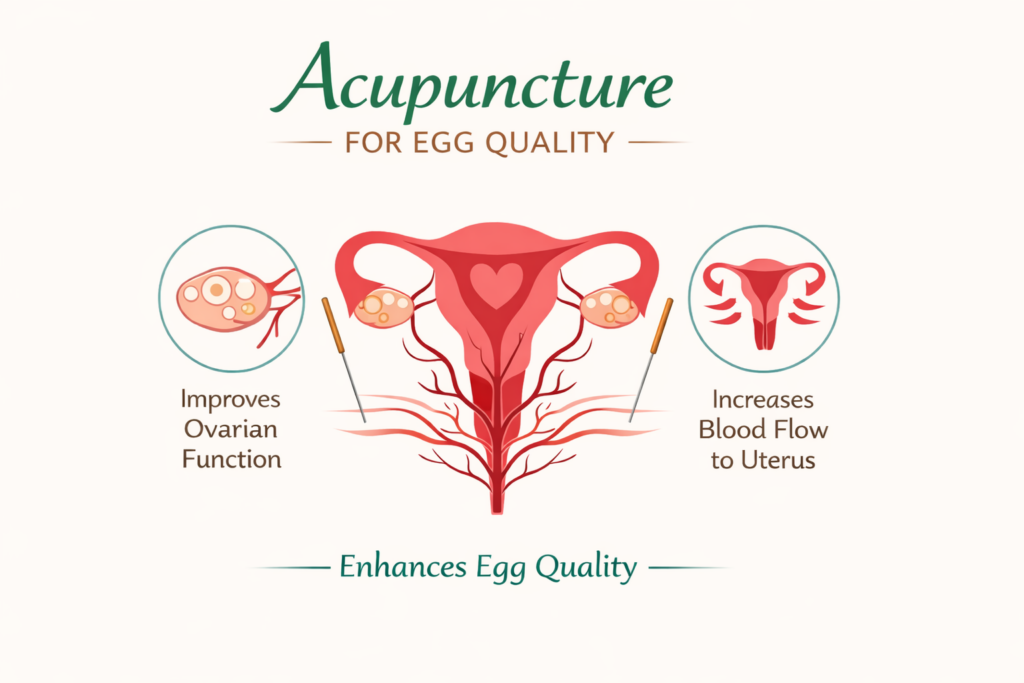
Research by Stener-Victorin et al. demonstrated that acupuncture can improve blood flow to reproductive organs by reducing sympathetic nervous system activity.
Improved circulation may support:
- follicle development
- ovarian responsiveness
- egg maturation
2. Nervous System Regulation
Chronic stress activates the sympathetic nervous system, which can negatively impact ovarian function.
Acupuncture helps shift the body into a parasympathetic (rest-and-repair) state, which may:
- improve blood flow to the ovaries
- reduce cortisol levels
- support hormonal signaling
This is particularly important for patients undergoing IVF, where stress levels are often elevated.
3. Hormonal Balance
Acupuncture may help regulate the hypothalamic-pituitary-ovarian (HPO) axis, which controls:
- follicle-stimulating hormone (FSH)
- luteinizing hormone (LH)
- estrogen production
Balanced hormonal signaling is essential for:
- proper follicle development
- egg maturation
Some studies suggest acupuncture may help normalize ovulation and improve ovarian response.
4. Reduced Inflammation and Oxidative Stress
Emerging research suggests that oxidative stress may negatively impact egg quality.
Acupuncture has been shown to have anti-inflammatory effects and may:
- reduce oxidative stress
- improve cellular environment
- support mitochondrial function
These mechanisms may contribute to improved egg health. In addition to acupuncture, we use red light therapy for egg quality, especially in women over 35. We have found significant improvement in the number of embryos that have made it to blastocyst stage in women who integrate both electro-acupuncture and red light therapy (LLT). We use Celluma devices (LED) and recommend at-home use of red light 3-5 days weekly if possible as well. We sell very reasonably priced red light devices for home use from Fringe.
What Research Says About Acupuncture and Egg Quality
While direct studies on egg quality are limited, several studies suggest acupuncture may improve factors associated with ovarian function and IVF outcomes.
A study published in Human Reproduction found that acupuncture improved ovarian blood flow and hormonal regulation, both critical for egg development.
Other clinical observations suggest that patients receiving acupuncture prior to IVF may experience:
- improved ovarian response
- better embryo quality
- higher pregnancy rates
A systematic review published in BMJ Open (Smith et al., 2019) found that acupuncture may improve clinical pregnancy rates, particularly when used consistently throughout IVF preparation.
It is important to note that results vary, and acupuncture is best used as part of an integrative fertility plan.
Why Fertility Acupuncture Is Especially Important Over 35
As egg quality naturally declines with age, patients over 35 often benefit from a more proactive approach.
Fertility acupuncture over 35 may help support:
- ovarian circulation
- hormonal balance
- stress reduction
- overall reproductive health
At Acupuncture Denver, we commonly recommend starting acupuncture at least 3 months before IVF or conception attempts, as this aligns with the follicle development cycle which starts about 90-150 days before follicles are at the antral follicle stage (visible on ultrasound).
Traditional Chinese Medicine Perspective
In Traditional Chinese Medicine (TCM), egg quality is not viewed in isolation but as part of the body’s overall balance.
Kidney Essence (Jing)
The Kidneys are considered the foundation of reproductive health.
Decline in Kidney essence is associated with:
- aging
- reduced fertility
- diminished ovarian reserve
Acupuncture treatments and Chinese herbal formulas aim to nourish and support Kidney energy. We have a custom herbal pharmacy, so we can tailor herbs to your specific needs and diagnosis.
Blood Nourishment
In TCM, healthy Blood is essential for nourishing the ovaries and uterus.
Deficiencies in Blood may be associated with:
- poor follicle development
- thin uterine lining
Acupuncture helps improve circulation and nourish Blood. Chinese herbs are wonderful blood tonics, in many cases, and we can create a formula and also recommend dietary therapy to build your blood and nourish your reproductive potential.
Liver Qi Regulation
Stress can disrupt the flow of Liver Qi, impacting hormonal balance.
Acupuncture promotes smooth Qi flow, supporting:
- emotional balance
- cycle regulation
- reproductive function
When Should You Start Acupuncture for Egg Quality?
Timing is critical.
Because eggs take approximately 90 days to mature, acupuncture is most effective when started:
✔ 3–4 months before IVF or conception attempts
✔ Weekly or twice-weekly treatments
✔ Continued through stimulation phase if doing IVF
This allows time to support the full follicular development cycle.
BOOK NOW or reach out to us if you have any questions about your care!
Clinical Insight from Our Practice
At Acupuncture Denver, we often see the greatest benefit when patients begin acupuncture early in their fertility journey.
Patients frequently report:
- feeling more balanced and less stressed
- improved menstrual cycle regularity
- greater sense of agency and emotional support during IVF
While results vary, acupuncture provides a supportive foundation for reproductive health.
Patient Takeaways
If you are concerned about egg quality:
✔ Acupuncture may support ovarian blood flow
✔ It may help regulate hormones and reduce stress
✔ Starting early (3+ months) is ideal due to the cycle of folliculogenesis
✔ It works best as part of an integrative fertility plan
Acupuncture does not replace medical fertility treatment, but it may enhance the environment in which eggs develop.
Considering Acupuncture for Egg Quality?
If you are preparing for IVF or trying to conceive—especially over age 35—acupuncture may help support your reproductive health.
At Acupuncture Denver, we specialize in fertility-focused care designed to support your body at every stage.
👉 Schedule your consultation today to create a personalized fertility plan.
FAQ Section
Can acupuncture improve egg quality?
Acupuncture may support egg quality indirectly by improving blood flow, regulating hormones, and reducing stress.
Does acupuncture help fertility over 35?
Many patients over 35 use acupuncture to support ovarian function and overall reproductive health. We have seen patients have extraordinary results after failed IVF cycles in either getting pregnant naturally or producing more euploid embryos in subsequent IVF cycles. It’s thrilling to see these outcomes either way!
How long does it take for acupuncture to affect egg quality?
Because eggs take about 3 months to develop, acupuncture is typically recommended for at least 3 months before IVF or conception.
Is acupuncture safe during fertility treatment?
Yes, when performed by a licensed practitioner trained in fertility acupuncture. All of our providers have OVER 20 years of clinical experience individually and are ABORM-certified as Reproductive Acupuncture and Chinese Medicine experts. We also come highly recommended by colleagues from out of state, local reproductive endocrinologists, and OBGYNs.
We perform on-site FET acupuncture at Conceptions and Kindbody, and receive referrals from reproductive endocrinologists at CCRM on a regular basis. We have been specializing in fertility in Denver since 2003, so we have supported thousands of clients through their fertility journeys and know the ins-and-outs of IVF protocols. Our patients know that we are rooting for them all the way and holding their hands and hearts through the process is our passion! We got you!
References
Stener-Victorin E et al. Human Reproduction
Smith CA et al. BMJ Open. 2019
Paulus WE et al. Fertility and Sterility. 2002