By Jane Gregorie, M.S., L.Ac., FABORM Owner & Clinic Director
Introduction
Endometriosis is one of the most under-recognized causes of infertility, affecting roughly 10% of women of reproductive age — and per the American Society for Reproductive Medicine, 25–50% of infertile women have endometriosis, and 30–50% of women with endometriosis are infertile (ASRM Practice Committee, 2012; Tanbo & Fedorcsak, 2017). If you have been diagnosed with endometriosis (or suspect you have it), and you are trying to conceive, you are likely navigating a frustrating mix of:
- painful periods and pelvic pain
- pain with intercourse, ovulation, or bowel movements
- difficulty conceiving even after months or years of trying
- worry about how endo will affect IVF or IUI outcomes
- fatigue, bloating, and inflammation that no one seems to have a clear answer for
Many women look for ways to support their fertility alongside conventional gynecologic and reproductive care. One of the most studied integrative options for endometriosis is acupuncture — and the research base has grown substantially in the last few years.
At Acupuncture Denver, we have spent over two decades helping women with endometriosis manage their symptoms and improve their chances of conceiving, whether they are trying naturally or preparing for IVF. This guide walks through what the current evidence says, how acupuncture may help, and what a personalized plan looks like in our clinic. Real-world outcomes from our patients can be read in our fertility success stories.
What Is Endometriosis — and Why Does It Affect Fertility?
Endometriosis is a chronic inflammatory condition in which tissue similar to the lining of the uterus (the endometrium) grows in places it does not belong — most commonly on the ovaries, fallopian tubes, pelvic peritoneum, bowel, and bladder. These lesions respond to monthly hormonal shifts the way the uterine lining does: they thicken, bleed, and break down — but because the blood and tissue have nowhere to go, they trigger inflammation, scarring, and adhesions.
According to the American Society for Reproductive Medicine (ASRM), endometriosis affects approximately 10% of reproductive-aged women. ASRM reports that 25–50% of infertile women have endometriosis, and conversely, 30–50% of women with endometriosis experience infertility (ASRM Practice Committee, 2012; ASRM Patient Booklet).
Endometriosis can impair fertility through several mechanisms (Tanbo & Fedorcsak, 2017; Bonavina & Taylor, 2025):
- Distorted pelvic anatomy — adhesions and endometriomas can block or damage fallopian tubes and ovaries.
- Chronic pelvic inflammation — elevated cytokines in the peritoneal fluid create a hostile environment for eggs, sperm, and embryos.
- Reduced egg quality — oxidative stress and altered follicular fluid composition may impair oocyte development.
- Endometrial receptivity issues — the uterine lining may be less receptive to embryo implantation.
- Hormonal dysregulation — including progesterone resistance and altered estrogen signaling.
It is also worth knowing that ASRM data show up to 50% of women with “unexplained” infertility may actually have undiagnosed endometriosis (Bonavina & Taylor, 2025). If you have unexplained infertility plus painful periods, endometriosis is worth investigating.
How Acupuncture May Help Endometriosis and Fertility (Biological Perspective)
Acupuncture is not a single-mechanism treatment. The current research base — including multiple systematic reviews and a landmark 2023 placebo-controlled trial published in Fertility and Sterility — suggests acupuncture may influence endometriosis and fertility through several converging pathways.
1. Reducing Pelvic Inflammation and CA-125
CA-125 is a serum protein commonly elevated in endometriosis and used as an inflammatory marker. A 2023 systematic review and meta-analysis of 14 RCTs (793 patients) in Medicine found that acupuncture significantly reduced pain severity, improved response rates, and lowered serum CA-125 levels compared to controls (Xu et al., 2023, Medicine).
Reducing pelvic inflammation matters for fertility because:
- it improves the quality of the peritoneal environment around the ovaries and tubes
- it reduces oxidative stress on developing eggs
- it may improve endometrial receptivity for implantation
2. Improving Pelvic and Uterine Blood Flow
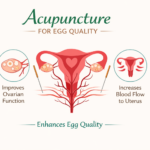
Acupuncture — especially electroacupuncture on lower-abdominal and lumbosacral points — has been shown to increase blood flow to the uterus and ovaries. Better pelvic circulation may support follicular development, egg quality, and the growth of a healthy uterine lining — three foundational elements for both natural conception and IVF success (Endometriosis Foundation of America).
3. Modulating Pain and the Nervous System
Endometriosis pain is driven not only by lesions but also by central sensitization — a nervous system “wind-up” that amplifies pain signals over time. Acupuncture activates descending pain-inhibition pathways, increases endorphin release, and shifts the autonomic nervous system from a sympathetic (“fight or flight”) to a parasympathetic (“rest and digest”) state.
In the 2023 multicenter, single-blind, placebo-controlled RCT published in Fertility and Sterility (Li et al., 4 tertiary hospitals, China; NCT03125304), acupuncture delivered three times per week starting one week before menses produced clinically meaningful reductions in endometriosis-associated pain compared to sham acupuncture over 12 weeks (Li et al., 2023, Fertility and Sterility). An accompanying editorial called this study “the birth of integrative reproductive medicine” for endometriosis (Norman, 2023).
Lower stress and lower pain levels also matter for fertility because chronic stress disrupts the hypothalamic-pituitary-ovarian (HPO) axis that governs ovulation.
4. Supporting Hormonal Balance and Ovulation
Endometriosis often coexists with hormonal imbalances — particularly progesterone resistance and elevated local estrogen production in lesion tissue. Acupuncture may modulate the HPO axis, supporting more regulated cycles and improved ovulatory function (Endometriosis Foundation of America).
5. Improving Endometrial Receptivity for Implantation
A 2025 umbrella overview in Frontiers in Medicine synthesized 10 systematic reviews evaluating acupuncture’s effect on endometrial receptivity in infertile women, with most pointing toward improvements in endometrial thickness, blood flow indices, and pregnancy rates — though the authors note that the methodological quality of underlying reviews varies and larger, higher-quality trials are still needed (Frontiers in Medicine, 2025).
What the Research Says: A Closer Look
The evidence for acupuncture in endometriosis has matured substantially since the original 2011 Cochrane review (which only had one eligible RCT). Here is a snapshot of what current research shows.
Landmark Placebo-Controlled Trial (2023)
The Li et al. multicenter RCT randomized patients with endometriosis-associated pain to either acupuncture or sham acupuncture over 12 weeks. Sessions were 30 minutes, three times per week, starting one week before expected menses, with daily treatment during menstrual pain. The acupuncture group showed significantly greater reductions in pain than the sham group, providing the strongest placebo-controlled evidence to date (Li et al., 2023, Fertility and Sterility).
Systematic Reviews and Meta-Analyses
- Xu et al., 2023 (Medicine) — 14 RCTs, 793 patients: significant reductions in pain severity, improved overall response, and lower CA-125 with acupuncture vs. control (PMC10682677).
- 2024 review in Archives of Gynecology and Obstetrics — confirmed acupuncture’s benefit for endometriosis-related pain across multiple study designs (Springer, 2024).
- Mira et al., 2020 — 6 trials, 331 participants: low-to-moderate certainty evidence that acupuncture reduces overall pelvic pain and menstrual pain compared to non-specific acupuncture (PMC10010596).
- 2024 Network meta-analysis in Journal of Pain Research — across 23 RCTs and 1,545 patients, electroacupuncture, auricular acupuncture, and warm needling all outperformed control groups; acupoint catgut embedding, auricular therapy, and combination approaches ranked best for endometriosis-related pain (Su et al., 2024).
- 2025 Archives of Gynecology and Obstetrics network meta-analysis — confirms acupuncture-related therapies are effective and safe for symptomatic endometriosis (Springer, 2025).
Acupuncture + Chinese Herbal Medicine
A 2025 Frontiers in Medicine meta-analysis found that acupuncture combined with Chinese herbal medicine significantly outperformed Chinese herbs alone for endometriosis-associated pain, with higher clinical efficacy rates and lower pain scores (Frontiers, 2025). This is consistent with what we see clinically at Acupuncture Denver, where most endometriosis patients benefit from a combined acupuncture + custom Chinese herbal formula protocol.
What About Endometriosis + IVF?
Endometriosis is associated with lower implantation rates in IVF, particularly in stage III/IV disease (ASRM, 2012; Bonavina & Taylor, 2025). However, recent SART data show that with appropriate protocols, live-birth rates in endometriosis patients can approach those of women with other infertility diagnoses. Integrative care — including acupuncture before embryo transfer and pre-cycle preparation — is one piece of optimizing those outcomes.
Bottom line: the evidence for acupuncture reducing endometriosis pain is now strong. The evidence for fertility outcomes in endometriosis specifically is more emerging, but the mechanistic pathways — reduced inflammation, better pelvic blood flow, improved endometrial receptivity, restored ovulation, and reduced stress — all point in a favorable direction.
Traditional Chinese Medicine Perspective on Endometriosis
In Traditional Chinese Medicine (TCM), endometriosis is most often understood as Blood Stasis — blood that should be moving freely is instead stagnating in the lower abdomen, creating pain, masses, and impaired function. But because each woman’s body is unique, the root of that Blood Stasis differs from patient to patient. Identifying the correct pattern is what allows us to design a treatment plan that actually works for you.
Blood Stasis (the core pattern)
Associated with:
- sharp, stabbing menstrual pain that worsens before and during the period
- dark, clotted menstrual blood
- endometriomas and fibrotic adhesions
Treatment focuses on moving blood, breaking up stasis, and restoring smooth pelvic circulation.
Cold in the Uterus
Associated with:
- pain relieved by heat (heating pads, warm baths)
- worsening pain in cold weather
- delayed cycles and clotting
Treatment uses warming acupuncture techniques, moxibustion, and warming herbal formulas.
Liver Qi Stagnation
Associated with:
- premenstrual irritability, breast tenderness, and bloating
- worsening pain during stressful periods
- irregular cycle length
Treatment focuses on smoothing Liver Qi, reducing tension, and supporting nervous-system regulation.
Kidney Deficiency
Associated with:
- long-standing fertility challenges
- low ovarian reserve, low AMH, or diminished egg quality
- low back pain and fatigue with menses
Treatment tonifies Kidney essence to support reproductive function over time.
Damp-Heat
Associated with:
- heavy, bright-red flow
- pelvic inflammation, recurrent infections
- yellowish or sticky discharge
Treatment clears Heat and resolves Dampness while still moving stagnant blood.
Most endometriosis patients have a combination of these patterns. A skilled, board-certified fertility acupuncturist will assess all of them and prescribe acupuncture point selections — and often a custom herbal formula — that match your individual presentation through each phase of your cycle.
What a Personalized Endometriosis-Fertility Plan Looks Like at Acupuncture Denver
We approach endometriosis-related infertility as a layered protocol that evolves with your cycle and your goals. A typical plan includes:
- Initial intake and TCM diagnosis — including a review of any imaging, labs (baseline fertility workup), and surgical history.
- Weekly or twice-weekly acupuncture — with point selection tailored to each phase of your menstrual cycle.
- Electroacupuncture — added on lower-abdominal and lumbosacral points to enhance pelvic blood flow and modulate pain pathways.
- Custom Chinese herbal formula — typically rotated across the follicular, ovulatory, luteal, and menstrual phases.
- Fertility-enhancing massage (FEM) — to mobilize pelvic adhesions and improve circulation.
- Red light therapy — for its anti-inflammatory effects on the pelvis.
- Targeted supplements — omega-3s, NAC, vitamin D, magnesium, and others as indicated, ordered through our Fullscript pharmacy.
- Lifestyle and anti-inflammatory nutrition guidance — building on our Fall Fertility Series on nutrition.
- Coordination with your reproductive endocrinologist — including timing protocols around IUI, IVF stimulation, and embryo transfer.
When to Start Acupuncture for Endometriosis Fertility
The most consistent finding across the research is that acupuncture for endometriosis works best when it is given time to work. The Li 2023 trial used 12 weeks of treatment. Most clinical protocols recommend at least three full menstrual cycles of consistent care.
For best results, we suggest:
✔ Begin 3–6 months before trying to conceive or starting IVF, if possible ✔ Weekly or twice-weekly acupuncture sessions ✔ Intensify treatment frequency around menses (when pain and inflammation peak) ✔ Continue support during IUI, IVF stimulation, and the two-week wait ✔ Include custom Chinese herbs between treatments when appropriate
Clinical Insight from Our Practice
At Acupuncture Denver, our endometriosis patients most commonly report:
- noticeably less period pain within 2–3 cycles
- shorter, lighter, less clotted periods
- reduced bloating, fatigue, and PMS
- calmer nervous system and better sleep
- more confidence going into IVF or IUI cycles
Many also conceive — sometimes naturally after years of trying, sometimes during an IVF cycle that finally “took” after an unsuccessful prior round. We never promise outcomes, but we do promise that you’ll be cared for by clinicians who are deeply experienced with this exact diagnosis. Jane, Merry, and Mally are all ABORM board-certified Reproductive Medicine Specialists and work hand-in-hand with most of Denver’s leading reproductive endocrinology practices.
Patient Takeaways
If you have endometriosis and are trying to conceive:
✔ Acupuncture has strong evidence for reducing endometriosis-related pain — including a recent placebo-controlled RCT in Fertility and Sterility ✔ It may lower inflammatory markers (CA-125) that affect the pelvic environment ✔ It can improve pelvic blood flow, supporting egg quality and endometrial receptivity ✔ Combined acupuncture + Chinese herbs appears to work better than herbs alone ✔ Consistency matters — plan for at least 3 cycles of regular treatment ✔ Acupuncture pairs well with conventional care, including IUI and IVF
Endometriosis can feel isolating. You do not have to navigate it alone.
Considering Acupuncture for Endometriosis and Fertility?
If you have endometriosis (diagnosed or suspected) and are trying to conceive — naturally or with the help of a fertility clinic — acupuncture may be a meaningful part of your plan. At Acupuncture Denver, we will design a personalized protocol around your:
- diagnosis stage and surgical history
- cycle patterns and pain triggers
- fertility timeline and treatment plan
- overall health and lifestyle
You’re also welcome to join our free monthly women’s infertility support group — a space we’ve held for nearly 20 years for women navigating exactly these questions.
Frequently Asked Questions
Can acupuncture cure endometriosis?
No therapy — acupuncture, surgery, or medication — currently cures endometriosis. Acupuncture has good evidence for reducing endometriosis-related pain and inflammatory markers and may support fertility by improving pelvic blood flow and endometrial receptivity. It works best as part of an integrative plan that may also include conventional gynecologic care.
Does acupuncture help with endometriosis pain?
Yes. Multiple systematic reviews and a 2023 multicenter placebo-controlled RCT published in Fertility and Sterility have shown that acupuncture significantly reduces endometriosis-associated pain compared to sham acupuncture or no treatment. Electroacupuncture, auricular (ear) acupuncture, and warm needling have all shown benefit.
How long does it take for acupuncture to help endometriosis?
Most patients begin to notice symptom changes within 2–3 menstrual cycles of consistent treatment. The 2023 Fertility and Sterility RCT used 12 weeks of treatment. For fertility-focused care, we recommend 3–6 months of preparationbefore trying to conceive or starting IVF, when possible.
How often should I get acupuncture for endometriosis?
In our clinic, most endometriosis patients receive one to two acupuncture sessions per week, with treatment frequency sometimes intensified around menstruation. Patients preparing for IVF often add sessions during stimulation and around embryo transfer.
Can acupuncture help me conceive if I have endometriosis?
It may. Acupuncture may help by reducing pelvic inflammation, improving uterine and ovarian blood flow, supporting endometrial receptivity, modulating hormonal balance, and reducing stress. It also pairs well with IUI and IVF, and emerging research supports its use to improve endometrial receptivity in infertile women.
Should I do acupuncture before IVF if I have endometriosis?
Yes — most fertility-focused acupuncturists recommend starting acupuncture at least 8–12 weeks before an IVF cycle, with continued treatment through stimulation, retrieval, and around embryo transfer. Patients with endometriosis often benefit even more from this preparation given the inflammatory component of the disease. See our post on acupuncture before embryo transfer for what the research shows on transfer-day timing.
Is acupuncture safe with endometriosis or while doing IVF?
Yes, when performed by a licensed, board-certified practitioner with advanced fertility training. All Acupuncture Denver practitioners are NCCAOM board-certified and ABORM certified as TCM Reproductive Medicine Specialists. We have worked alongside Denver’s leading reproductive endocrinologists for over two decades.
Do you use Chinese herbs for endometriosis?
Yes. We have a full Chinese herbal pharmacy and create custom granular formulas tailored to each patient’s TCM diagnosis and cycle phase. Recent meta-analytic evidence shows that acupuncture combined with Chinese herbal medicine outperforms herbs alone for endometriosis-associated pain. All herbal recommendations are screened for safety alongside any pharmaceuticals or fertility medications you may be taking.
What’s the difference between acupuncture for endometriosis and acupuncture for PCOS?
Both are gynecologic conditions where acupuncture may help fertility, but they target different physiology. Acupuncture for PCOS focuses on insulin resistance, androgen modulation, and restoring ovulation. Acupuncture for endometriosis focuses on reducing pelvic inflammation, moving stagnant blood, improving uterine blood flow, and modulating pain pathways. Many patients have both — and we treat them with a coordinated, individualized plan.
References
- American Society for Reproductive Medicine Practice Committee. (2012). Endometriosis and infertility: a committee opinion. Fertility and Sterility.
- ASRM. Endometriosis patient education booklet. ReproductiveFacts.org.
- Tanbo, T., & Fedorcsak, P. (2017). Endometriosis-associated infertility: aspects of pathophysiological mechanisms and treatment options. Acta Obstetricia et Gynecologica Scandinavica.
- Bonavina, G., & Taylor, H. S. (2025). Endometriosis and infertility: pathophysiology, treatment strategies, and reproductive outcomes. Archives of Gynecology and Obstetrics.
- Li, P. S., et al. (2023). Efficacy of acupuncture for endometriosis-associated pain: a multicenter randomized single-blind placebo-controlled trial. Fertility and Sterility, 119(5), 815–823.
- Norman, R. J. (2023). The birth of integrative reproductive medicine: finally, a randomized controlled trial for endometriosis treated with acupuncture! Fertility and Sterility (editorial).
- Xu, Y., et al. (2023). Acupuncture for endometriosis: A systematic review and meta-analysis. Medicine.
- (2024). Acupuncture for clinical improvement of endometriosis-related pain: a systematic review and meta-analysis. Archives of Gynecology and Obstetrics.
- Mira, T. A. A., et al. (2020). Acupuncture for pain in endometriosis. Systematic review.
- Su, X., et al. (2024). Acupuncture and Related Therapies for Endometriosis: A Network Meta-Analysis of Randomized Controlled Trials. Journal of Pain Research.
- (2025). Efficacy and safety of acupuncture-related therapies in symptomatic endometriosis: a systematic review and network meta-analysis. Archives of Gynecology and Obstetrics.
- (2025). Acupuncture combined with Chinese herbal medicine versus Chinese herbal medicine alone to improve clinical efficacy in treating endometriosis-associated pain: a systematic review and meta-analysis. Frontiers in Medicine.
- (2025). The efficacy of acupuncture on endometrial receptivity in infertile women: an overview of systematic review and meta-analysis. Frontiers in Medicine.
- Endometriosis Foundation of America. How Traditional Chinese Medicine & Acupuncture Supports Endometriosis Pain Management.
Medical disclaimer: This article is for educational purposes only and is not a substitute for personalized medical care. Acupuncture and Chinese herbal medicine should be provided by a licensed, board-certified practitioner with advanced fertility training, in coordination with your reproductive endocrinologist or OB-GYN.